

In recent days, an episode in Canada has sparked strong reactions.
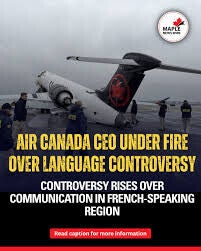
Following a tragic accident, the CEO of Air Canada publicly addressed the situation to express his condolences. His message was delivered mostly in English, with only a brief “bonjour” and “au revoir” in French.
Yet the statement was made from Montreal, in a country that is officially bilingual—and, more importantly, in a province where the status of French is anything but neutral.
The reaction was immediate: thousands of complaints, a summons before a parliamentary committee… and, a few days later, his departure.
One could frame this as a communication misstep, or a lack of sensitivity. But what is particularly striking here is that the issue lies less in what was said than in the language in which it was delivered.
And that changes everything.
Because language is never just a channel. It carries history, it reflects the place we give to others, and it reveals—often implicitly—a certain balance of power.
In the Quebec context, French is not simply one language among others. It is a strong marker of identity, shaped by a long-standing tension with English. Not using it—especially in such a symbolic moment—may be perceived not as a minor oversight, but as a form of non-recognition.
What stands out in this situation is not the leader’s level of fluency. It is the fact that he did not anticipate what this choice would signal. As if language were, for him, a purely functional tool—whereas for others, it is deeply symbolic.
This is a dynamic we often see in international organizations. A dominant language establishes itself—often for valid operational reasons—without its effects being fully considered. Some adapt, others withdraw, and the resulting imbalances are rarely named for what they are.
Instead, we speak of lack of impact, difficulty in convincing, or issues of presence… when, in some cases, it is simply a question of legitimacy—granted, or withheld—through language.
Ultimately, intercultural competence is not just about speaking multiple languages. It is about understanding what each language represents for those who carry it, and what its use activates—often far beyond words.
And sometimes, overlooking this is not just a misalignment… but a leadership mistake.
Add comment
Comments